Conclusion
The next competitive layer for agents may not be the model, prompt, or one-off tool call. It may be three things that are often treated as implementation detail: a computer environment that can continue across time, a communications identity that can be controlled, and a research-to-action trail that can be inspected later. This is a falsifiable thesis, not a claim that the layer has already won. If people ultimately pay only for individual chats, isolated generations, or single API calls, then computers, identities, and research access will remain expensive demonstration features rather than a durable infrastructure category.
This article was rechecked on 2026-08-19. The machine0 page does not state a publication date; the Inkbox and OpenClaw dates follow the source notes below. The three sources describe different products or release practices and do not validate one another.
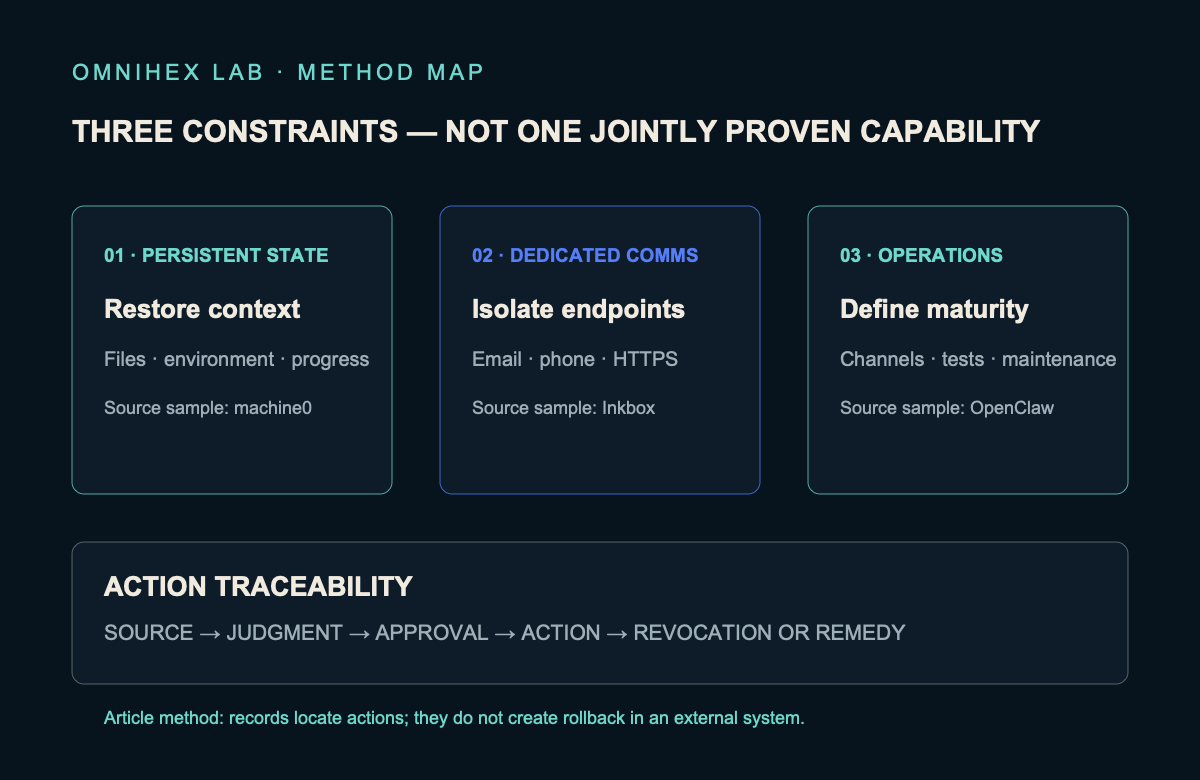
Figure: each first-party source supports only one public description; cross-layer action traceability is the evaluation method proposed here.
Confirmed facts
Public materials show different parts of this direction. machine0 describes persistent VMs that can be suspended, snapshotted, and resumed, along with profiles for injecting tools and configuration. These are first-party product claims, not an independent verification of reliability, security, or adoption. Inkbox’s Y Combinator launch page lists email, phone, iMessage, a persistent internet address, and an encrypted credential vault. OpenClaw’s post on extended stable releases and maturity scorecards describes an extended-stable channel and maturity scorecards; its statement that more than 90 percent end-to-end coverage remains a goal must not be read as an achieved reliability result.
Those sources establish only a limited observation: teams are using persistent environments, communications entry points, or stable operation as public product language. They do not show that these capabilities have broad demand, or that any particular product has solved security, delivery quality, retention, or unit economics. Putting the three references together is a way to notice a shared design problem, not a claim that the products are interchangeable or that one validates another.
The mechanism behind the thesis
A one-shot chat can end in one sitting: a person asks, a model responds, and the person copies, judges, or carries out the next action. Work that spans days reveals a different set of requirements. It needs an execution environment that can retain files, state, and partially completed tasks. It needs an identity layer that does not hand a person’s private phone number, inbox, or account permissions to a model without boundaries. It also needs a way to revisit why an action was proposed and what evidence was used.
“Computer” in this thesis does not require a physical device assigned to every agent. It means an environment with limits, observability, and a recovery path. “Identity” does not mean handing an agent a permanent secret. It means separating communications addresses, authorization scope, logs, and revocation. “Research access” does not simply mean a larger search box. It means that sources, timing, extraction, conclusions, and actions can be connected well enough for a person to review them when something matters.
These three layers reinforce one another. Without a persistent environment, a long task must reconstruct its context after every interruption, and file or browser state can disappear. Without a controlled identity, an agent may be able to prepare research but cannot safely send a question, receive a reply, access an external service, or act repeatedly for a team. Without a traceable research trail, the user cannot separate a model inference from a cited source or an action already taken; correcting an error then becomes a search through opaque history. Better models make these gaps appear more often, but they do not resolve them by themselves.
The resulting competition could be less about who can complete a spectacular task and more about who can let an ordinary, consequential job continue under control. A research workflow might collect public sources, preserve candidate conclusions, wait for human approval, send an inquiry through a separate communications identity, then archive the reply with the relevant source record. None of those stages requires a fictional general intelligence. All of them require state, permissions, records, and recovery paths to work together. The infrastructure value is not necessarily that an agent becomes human-like. It is that a person can see where the agent is allowed to act and where it must stop.
This distinction matters for product design. A model can appear capable in a short demo even if a user cannot resume it after a browser closes, cannot inspect what it saw, cannot cancel a queued action, or cannot revoke a credential without breaking unrelated work. Those are not peripheral usability details once an agent participates in recurring operations. They determine whether a team can delegate a small part of a workflow without accepting an unbounded operational risk.
What would make the thesis true
The thesis should be tested through repeatable work, not a growing list of feature nouns. Supporting evidence would look like users repeatedly paying for the same cross-session job because it can survive interruption; identities can be granted and revoked at a useful level of granularity; sources and actions are auditable; errors can be located and rolled back; and the system reduces real coordination time rather than adding setup work.
One useful test is whether the layers make a workflow more recoverable. When a task fails, can a person distinguish an expired permission from a broken site, an unsupported action, a bad source, or an incorrect model conclusion? Can they stop the correct process without deleting all history? Can a replacement person understand the task state? Durable work usually needs those answers more than it needs another generic capability claim.
Another test is whether the user retains meaningful control at the decision boundary. Long-running automation does not have to mean end-to-end autonomy. In many valuable cases, an agent may prepare options, maintain context, and execute only after a narrow approval. If the infrastructure makes approvals specific and reversible, it can make modest automation usable. If it merely hides more autonomous behaviour behind a reassuring interface, it increases the cost of trust.
Counterexamples and limits
The counterarguments are substantial. Many valuable jobs do not require an agent to have its own phone, email address, or computer. Human handoff at a consequential step may be cheaper and safer. Creating isolated environments and communications identities can add cloud cost, number reputation issues, abuse prevention, anti-spam work, privacy duties, credential-leakage risk, and support burden. A polished permissions screen does not prove that users understand an authorization scope, nor that an external platform will trust an automated identity.
Persistence is not automatically a benefit either. The longer a state is retained, the more likely it is to accumulate stale context, contaminated files, overbroad permissions, or unnoticed loops. Language about stable releases and maturity can indicate that a team is attending to reliability, but it cannot substitute for incident data, recovery times, permission audits, or evidence of sustained customer use. In high-risk contexts, the sound design may remain “agent prepares, person executes,” rather than autonomous completion.
There is also a market limit. A user may appreciate a dedicated environment or separate identity while refusing to pay for it independently. The value may be captured by an operating system, a collaboration suite, a cloud provider, or an existing agent platform rather than a standalone vendor. The thesis does not predict the winning packaging. It predicts only that the underlying responsibilities may become visible enough to compete on.
What would falsify it
The thesis should be downgraded if these components remain primarily demos, one-time trials, or minor add-ons to model capability; if safety and abuse costs consume their benefits; or if most teams continue to take back control before every external action. It is also weakened if users obtain the same reliable outcome with stateless tools and ordinary human-operated accounts, without persistent environments or independent agent identities.
The observation therefore asks a narrow question: can persistent compute, controlled identity, and traceable research be combined into a workflow that people repurchase and still trust after an error? The answer is not available from the three sources alone. Their value is to identify the components and make the question testable.
Public sources
- machine0 — machine0, origin
- Inkbox launch — Y Combinator, public launch record
- OpenClaw stable releases — OpenClaw, stability and maturity context